Why Wearing Basically the Same Thing Every Day Might Be the Most Stylish Move You Make
Steve Jobs had his black turtleneck. Barack Obama famously stuck to gray or blue suits to eliminate one daily decision. Matilda Kahl, a creative director in New York, wore the same white silk blouse and black trousers to work every day for years and wrote about it publicly, calling it one of the best decisions she ever made.
These aren't people who gave up on style. These are people who figured something out.
Uniform dressing — the practice of building your wardrobe around a consistent formula, a repeating set of silhouettes, colors, and pieces — has a bit of a PR problem. It sounds like settling. Like you've run out of ideas, or you just don't care anymore. But spend a little time with it and you'll find the opposite is true. Constraint, done right, is one of the most powerful creative tools there is.
The Decision Fatigue Problem Nobody Talks About
Here's what's actually happening when you stand in front of a full closet at 7:30 in the morning and feel completely overwhelmed: your brain is already tired.
Decision fatigue is real, and it hits harder than most people realize. Every choice you make — even small ones — draws on a finite pool of mental energy. By the time you've cycled through outfit combinations, second-guessed yourself twice, and changed once, you've already spent cognitive resources that could have gone toward something that actually matters to your day.
A personal uniform sidesteps this entirely. When you've already made the high-level decisions — I wear dark denim, a simple top, and a great shoe — the daily version of that decision becomes almost automatic. You're not choosing what to wear, just which version of your formula makes sense today.
The result? You walk out the door feeling put-together without having burned through your morning focus. That's not laziness. That's efficiency.
What a Personal Uniform Actually Is (And Isn't)
Let's clear something up: a personal uniform isn't a literal outfit you repeat daily, necessarily. It's more like a formula. A consistent set of parameters that define your style and make decision-making easier without making you look like you own one pair of pants.
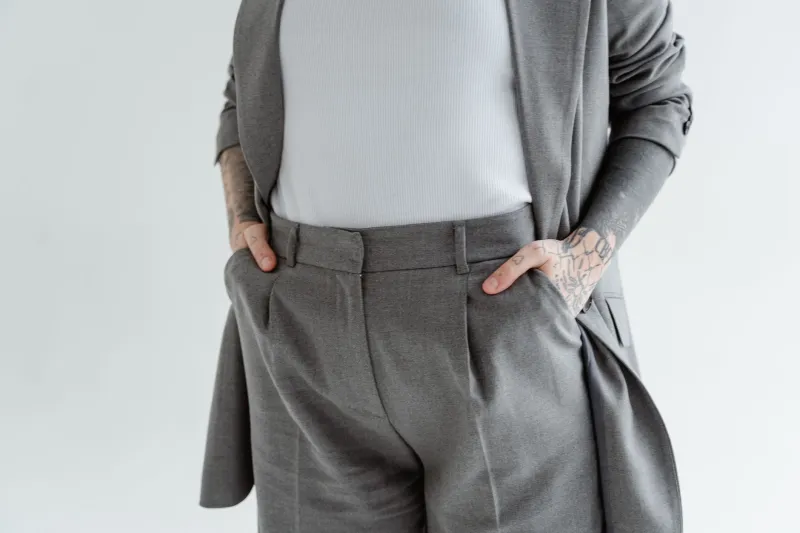
For some people, it looks like: tailored trousers + fitted crewneck + loafers, rotated through a palette of five or six colors. For others, it's: midi dress + ankle boot + simple gold jewelry, full stop. For others still, it might be: relaxed denim + a great blazer + clean sneakers, every single day.
The specifics don't matter as much as the consistency. You know your silhouettes. You know your colors. You know what works. Everything you buy fits into the formula, and everything you own works with everything else.
The Paradox of Creative Constraints
Here's the counterintuitive part: when you limit the variables in your wardrobe, creativity doesn't disappear. It actually intensifies — just in a more focused direction.
When you know you work in a palette of navy, cream, and warm tan, you stop wasting energy on whether that rust-orange top might work and start spending your attention on texture, proportion, and the really interesting details. You notice the difference between a well-cut trouser and a mediocre one. You start caring about fabric weight and the way a seam hits. The quality of your choices goes up because you're not distracted by quantity.
This is what the most consistently stylish people seem to have figured out. Their outfits don't look effortful because they're not — but they look considered, because the framework they're working within is so well-defined that every piece within it is a good one.
Building Your Own Formula: Where to Start
If you want to experiment with uniform dressing, you don't have to overhaul your wardrobe overnight. Start by identifying what you already wear on repeat — those are the pieces that are trying to tell you something about your instincts.
From there, ask yourself:
What silhouettes do I consistently feel good in? Not what looks good on a hanger or on someone else — what actually works on your body and in your life.
What color palette keeps showing up in my "wins"? Look at the photos where you felt great, or the outfits you got compliments on. Is there a pattern? Most people's natural palette is narrower than they think.
What's my lifestyle actually asking for? A personal uniform that works for a freelance designer in Austin looks different from one that works for someone in a corporate office in Chicago. Build for your real life, not your theoretical one.
Once you have a rough formula, test it. Wear it. See what feels like a natural extension of it versus what feels forced. Refine from there.
The Shopping Upside
One of the most underrated benefits of uniform dressing is what it does for your shopping habits. When you have a clear formula, it becomes a lot easier to evaluate whether something is actually worth buying.
Does it fit the formula? Does it work with at least three things you already own? Does it add something genuinely useful — a new texture, a better version of something you already have — or is it just interesting in isolation?
That clarity cuts through a lot of impulse-buy noise. You stop buying things that are exciting in the store and useless in your closet. You start buying things that actually integrate, that earn their place, that make the whole wardrobe stronger.
On Looking Like "Yourself" More Often
Maybe the best argument for uniform dressing is this: when you wear a consistent formula, you start to look like yourself all the time — not just on the days when the outfit stars align.
There's something really powerful about that. Style stops being something that happens to you on good days and starts being something you actively express every day. Not because you're trying harder, but because you've built a system that makes it easy to show up looking and feeling like you.
That's the real freedom in limiting your choices. You don't get fewer options — you get a clearer, more confident version of the one option that was always right for you.